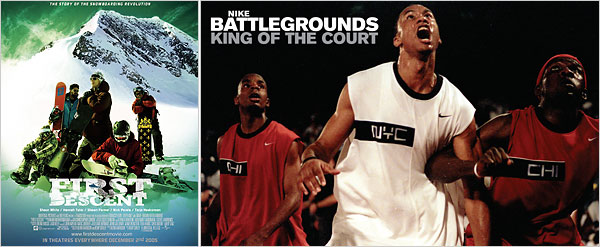
Produced by marketers, a movie by Mountain Dew, left, and a show by Nike.
Il y a plusieurs articles /mois sur ce thème dans la presse généraliste comme spécialisée aux Etats-Unis; mon objectif n'est bien sûr pas de tous les reprendre, mais de retenir ceux qui me semblent riches en exemples concrets (les non initiés me pardonneront, celui-ci étant particulièrement long !). From Louise Story / New York Times)
Marketers have found a new way to try to keep viewers from tuning out: offer them TV shows, movies and online programming created by the marketers themselves, often with help from their advertising agencies.
(...)
Burger King, for example, is making a feature-length film that may star — no surprise here — the “King” character of its ad campaign. Office Max recently created a show on the ABC Family channel. Anheuser-Busch plans to start a seven-channel TV network online, called BudTV.It’s the exploration of sort of a new world,” said Doug Powell, chief integrator of Maiden Lane, an advertising agency. “Clients would love to have a way for customers to be able to participate with their brands more often and not have to rely on the traditional media world.”
Marketers have become alarmed as consumers increasingly bypass commercials using digital video recorders like TiVo, and spend more time flipping among a wide array of television networks, Internet sites and video games.
(...)
“What we’re trying to do is find new ways to continue to be relevant to teens and to young adults,” said Vic Walia, the senior brand manager for Snickers, a Mars brand that created an online show called “Instant Def” with its agency BBDO New York,
The “Instant Def” home page looks like a video game for teenagers. Four hip-hop performers — played by actual hip-hop stars will.i.am, Fergie, Taboo and apl.de.ap — pose in front of a gritty urban scene. A fluorescent Snickers sign blinks atop a tower in the background. A Snickers factory played a vital role in the first episode, when a candy-mix explosion gave the stars superhero powers.
So far, about one million people have visited InstantDef.com, where the five episodes are available.
Advertiser-produced content — often called branded content — is a nascent trend. Companies commonly pay to place their products in TV shows and movies, but only a few dozen have created content from scratch. About 25 national companies produced online films this year, up from 5 last year, said Matt Wasserlauf, chief executive of Broadband Enterprises, a New York company that helps companies like Warner Brothers and AT&T circulate their videos on the Internet.
(...)
Advertisers say they are prepared to give the shows to networks free or in exchange for commercial air time; such offers could appeal to networks looking to control costs. But some network executives voiced skepticism that advertiser-created shows would draw much audience and said, for now, they do not expect to run many of the programs.
“The networks are reluctant to give their programming air over to advertiser-funded content,” said Guy McCarter, the director of branded entertainment at OMD. “If the TV marketplace softens, then I think there’s going to be more receptivity.”
Part of the reason more advertiser shows are put on cable, ad executives said, is that cable networks often feature shows on niche topics that appeal to specific types of customers. Procter & Gamble’s show, “Home Made Simple,” based on home-making tips available on the company’s online magazine, is on TLC, for example.
When Office Max decided it wanted to produce a show, company officials approached Disney because they had already committed themselves to advertise on Disney networks. Disney put the program, a reality show about preteenagers getting ready for high school, on ABC Family. On TV, about one million households watched the show, which featured several Office Max products. It was viewed more than six million times online.
William Bonner, a spokesman for Office Max, said the show gave viewers “content they could appreciate and interact with more than a 30-second commercial.”
ABC Family worked with Office Max and its ad agency DDB Chicago in developing the show, but “Schooled” was largely driven by Office Max and its agency’s vision, said David Rolfe, production director of content for DDB Chicago. Laura Nathanson, executive vice president for ad sales at ABC Family, said “Schooled” was a special case, and the cable network did not have immediate plans to do more shows with advertisers.
“We’re in the business of original production,” Ms. Nathanson said. “Anything that’s going to go on our air, we’re going to shepherd.”
Shows and movies on Turner Entertainment “first and foremost have to fit our brand,” said Linda Yaccarino, executive vice president for ad sales and marketing at Turner, which recently ran a series of mini-shows on TNT that were produced with Chase Card Services, which is part of J. P. Morgan Chase
Advertisers are also making movies. Nike has produced several, including a documentary on CBS about Lance Armstrong’s training for the Tour de France. Grey Goose paid for a six-part documentary that ran on the Sundance Channel and featured pairs of stars like Robert Redford and Paul Newman chatting. In both cases, the companies’ brands were not emphasized.
Last December, Mountain Dew, a PepsiCo brand, produced a movie about snowboarding that ran in theaters nationwide. Though Mountain Dew produced the movie, the soft drink was not featured in the film and only “MD Films” appeared in the opening credits. Mountain Dew and PepsiCo were thanked in the closing credits, but viewers had to be in the know to associate the movie with Mountain Dew.
Nicole Bradley, a PepsiCo spokeswoman, said the approach worked well. “Focusing on product placement would have only been a distraction,” she added.
The line between commercialization and entertainment is a tricky one, ad executives said. Before a Unilever-produced show called “The Gamekillers” was shown on MTV last spring, the network promoted it as a TV show and Unilever held off running ads related to the show. Only after the show ran were characters from it included in ads for Unilever’s Axe deodorant, said John Shea, executive vice president for integrated marketing and brand partnerships at MTV. “The last thing anyone of us wanted was for the show to feel that it was, in fact, an ad,” Mr. Shea said.
Ad executives say they expect more TV networks to accept their shows. BBDO North America is creating two shows it will pitch to networks, including a 13-episode series, said Brian DiLorenzo, the executive director of content. “Brands have potential to be good characters,” Mr. DiLorenzo said.
But persuading TV networks involves a bit of “arm wrestling,” said Jon Kamen, chief executive at @radical.media, which produces films and TV shows for advertisers. “It’s critically important that the broadcast networks and cable embrace this shift now rather than resist it,” he contended, adding they must be wary of forcing “advertisers to go elsewhere — because there is elsewhere to go.”
Anheuser-Busch is investing heavily in creating content. The beer company, known for its funny commercials, plans to put online a seven-channel televisionlike network called BudTV in February. It will feature reality shows, comedy skits, sports programs and user-generated content.
“If we do it right, then we’re going to have a pretty attractive demographic group,” said Anthony T. Ponturo, vice president for global media and sports marketing for Anheuser-Busch.
Ad executives said BudTV might be attractive to other advertisers as well.
“If BudTV can garner the right audience relative to that male 24 to 32 middle-income demographic in flyover states, there will be other advertisers that are going to want to reach that audience,” said Doug Scott, executive director for branded content and entertainment at Ogilvy North America.
Networks, magazines and sports associations like the N.F.L. have already approached Anheuser-Busch to talk about partnerships, Mr. Ponturo said. BudTV’s content, though, will “serve one master,” Mr. Ponturo said, “and that’s ourselves and our brands.”
The Ford Motor Company is filming a documentary tracking its effort to turn itself around, and is showing the film online. Since it began appearing in June, a million unique visitors have visited the Web site, said Whitney E. Drake, a Ford spokeswoman.
Consumer brand companies have been using the Internet to promote their messages through their own online magazines and blogs for several years. “The advertiser has a direct link to the consumer now,” said Nick Law, the chief creative officer at R/GA, at the Boards Summit in New York last week. “They don’t have to use an agency or production company.” (eh, Nick, faut pas déconner ?!!)
The next online phenomenon could be created by a consumer brand company, said David Droga, creative chairman of Droga5. Online hits “don’t have to be brought out by people in a garage,” he said.
It is unclear, of course, if advertisers will be able to produce shows that will hold consumer attention. “We are living in a world now where it’s harder and harder to capture somebody’s undivided attention,” said Linda Kaplan Thaler, chief executive for Kaplan Thaler Group.
Ms. Kaplan Thaler recently created a campaign for Dawn that included online shows, traditional commercials, a contest, and Ellen DeGeneres as a celebrity spokeswoman. She said advertisers had to do it all these days. “Ubiquity is the new exclusivity,” she said. (CQFD !)
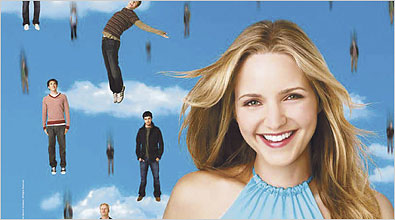 Match.com will sponsor the new TBS program “My Boys,” whose young characters are searching for love in Chicago.